Can You Feel It?
I’ve been working on something pretty important lately, and that something is a playlist of house music that samples talking. I love it so much, I hardly know which track to single out. Many make me laugh. Many are moving. And several of these songs are classics, although the Apple catalog leaves much to be desired. (I’m sorry to say that I miss Spotify. Apple Music has higher quality files for sure but I despise its counterintuitive, limiting, and obnoxious [non] functionality. Worse, all the good playlists are on Spotify along with a bunch of Japanese music that Apple either doesn’t have or has named in a way I can’t find because of course Apple’s search sucks, too.) If you have suggestions, let me know, but I left off lots of eligible songs that fit the bill because I don’t like them. This is basically the vibe, though it kind of goes all over the place:
Writers (re)teaching themselves to read is a pretty common genre of post right now, but so far this year I’ve been more concerned with my relationship to music. It’s one of the chief joys of life but easy to take for granted and relegate to the background. That’s a travesty. Like being married to your soulmate but never touching them.
So I prioritized listening as a discrete activity. It should have been straightforward: just sit down and press play. But when I made the effort, I still felt inhibited and frustrated, like my listening was superficial. Predictable, perhaps, given that degraded attention is a ubiquitous affliction but whatever was happening to me/in me was more subtle and nefarious than checking-the-phone-too-much disease. Instead, I felt psychically oppressed by the abundance of riches that hovered in my mental periphery every time I went to play some music, which I do only through a computer and only through an app, where I’m unavoidably assaulted with offerings upon opening. I didn’t have decision paralysis because I could pick something to play. But I felt I couldn’t fully lose myself in or give myself over to what I had picked. (Making playlists of intentional theme and order is one way of improving focus, hence “Talky House.”)
In my estimation, literature and written media on the whole are in a death spiral—though in preparation for rebirth, not extinction—and the situation is even worse for film and TV. But in terms of quality, music is coming through the 2020s better than any other art form. It’s really not even close. People are recording exquisite, thrilling work, and I don’t want to listen to less of it. I hate the prospect of missing the sort of song that could remake my whole soul. I know the missing is inevitable, but I don’t want to increase the odds by eschewing the new and unfamiliar. Yet confronting the deluge unassisted feels like diving into a landfill in search of rice-sized diamonds. It’s not that I don’t have my own methods for selection and discovery—I do. But the methods don’t stave off a sense of overwhelm. It can be a big pleasure to root around on my own, but it’s nice to know I have help when I want it. That’s where recommendations (are supposed to) come in.
But there’s no true taste-making anymore. There’s only paid promotion, fake hype, skewed opinions, influencers, useless reviews, and no reviews. I don’t need anyone to tell me whether something is good or bad because I have my own brain. But I prefer to be in the landfill—ok, let’s upgrade it to a flea market—alongside people with finer eyes and different educations than my own, who can make distinctions I can’t. People who can say “wait a minute, let’s give that a second look,” or “you might be interested in this…” And then I can be like “wow…. what is this sound…. some of these tracks are slamming hard.”
To survive a perpetual content tsunami, we need anchors. We need big strong trees to hold fast to, or at least I do, lest I be swept away. And if we manage to grab onto one, we should scream so everyone else knows where to find it. I personally need to get obsessed with certain songs and books, and I need to be obnoxious about and insistent upon my obsession, and I need other people to do the same. Your obsession and my obsession are probably not going to overlap, but passion means something right now. Please give me your passion, your real, selfless passion. Give it to me!!! Care about something!!! Shove it in my face!!!! You don’t have to write a think piece about it. Just get the word out.
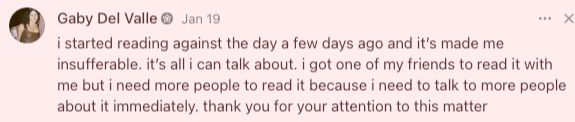
This is what I'm talking about. Good books (music, art) gives you brain worms and those brain worms should be passed along. Don’t hoard your worms.
The founding notion of Reading Writers was, essentially, that exhilaration is contagious and worth sharing. If a book makes you ponder or experience a strong emotion, even if that emotion is disdain or irritation, and even if that pondering never resolves into a definitive answer, it’s beneficial to indulge in and expand upon. Writing true criticism takes a long time and famously pays little to nothing. So I can’t write criticism about every worthwhile book I read or do I want to. But I can enthuse about them. I can still (I hope) say something worth saying.
I’m a little ambivalent about coming out as pro-recommendation because I know too well that it’s a tempting form of low effort content. Everything’s so scammy these days due to ~the algorithm~ and the precarity and desperation it fosters. Affiliate links, personal branding—blech. But if the alternative is just not talking about what we enjoy, the alternative must be refused. Getting offline is a solution to many problems but the truth is that I need people in my phone to help me find talky house songs because this is not a niche of knowledge among the people who populate my bodily space. And my life has been changed by so many offhand tips from strangers, solicited and otherwise. When Obama was still in office someone on Twitter replied to my idle, blanket inquiry into what good books everyone had recently read with As Meat Loves Salt, which entered and then remained in my top 5 books of all time. I’m sure this sort of exchange still happens all over social media, despite the conditions being so hostile.
One last wonkily related thing I’d like to mention. There’s a common misapprehension that being unable to remember the plot of a book or your experience of reading it is a symptom of phone brain. I don’t think so. It’s just the nature of being subject to time. When I was 21 and dating a man twice my age, I often mentioned a movie to him and he would say, “I think I saw that.” I would be appalled. You think? You can’t remember? A movie you watched? Do you have dementia? I refused to believe this would happen to me after I’d lived as long as he. I was young and also, separately, an idiot. I’ve been around for over 15,000 days at this point. Comprehensive recall is not necessary.
When certain states or habits or realities are attributed to phones, the condition immediately becomes ontologically wrong. (Am I using that word right? Don’t even tell me.) What I mean is that the situation instantly feels more dire and fatalistic—like, it’s been imposed on me and has mutated me, I’ve been turned into a different being against my will! I’m not denying phones have fucked us up but the point is that, phone or no, not every artwork is going to ostentatiously hook its barbs into our hearts and that fact is not an emergency. Nor it proof that the movie or song or book didn’t have an impact on you or wasn’t worth your time. We aren’t great at knowing what changes us or how. Do you remember every cloud you ever looked at? Of course not, but that isn’t a reason not to look.